
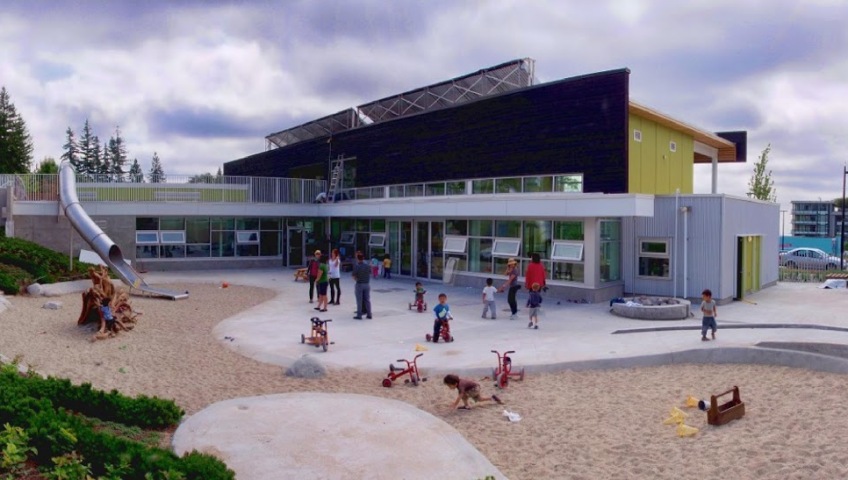
Lessons from SFU

This past week we submitted Drawings to the city for Building Permits and are awaiting their return.

We had very insightful conversations with Mahvash Kourosh and Dale Mikkelsen who were key in developing the Simon Fraser University Child Care Centre   These conversations provided some great leads for water system and material sourcing.  Some highlights:

– Water petal is once again looking much more promising after talking to the suppliers of the SFU system.  We look forward to reaching a decision about the water systems in the next few days

– Materials Petal is still being a bit elusive.  We are confident that meeting the red list requirement will be pretty straight forward (probably the optimist in us coming forth).  But the challenge for this project may lie in the FSC lumber requirement.  In Canada FSC lumber is not readily available.  Don’t miss understand, there is a lot of FSC cut blocks in BC but the lumber from those cut blocks is shipped directly to the US.  For us to procure FSC lumber we actually need to purchase the wood in “lifts” (that is a huge pile of lumber) and have it trucked back up to us from the Portland or Seattle.  Not a very good carbon foot print. We are working towards using the same strategy as SFU did with their lumber procurement by purchasing wood directly from mills that were processing “Pine beetle killed lumber that was destined to be clearcut anyway in order to stem the spread of the infestation.”

Met with our clients again today and we had some very lively discussion around the various petals of the Living Building Challenge.  They are both very excited to be part of the process.

Lastly, The Vancouver Foundation has graciously offered to extend the deadline for their assisted living grant funding to the end of January.  This will give us time to receive our Building Permits and get our material packages ordered.

Look forward to an exciting week.
 

Reality Check

Well just got off the phone with a lady from the Living Building Challenge and we are not feeling quite as optimistic as we once were.  Some huge challenges that we need to address are:

  • All black water (poo and pee) must be processed on site.  That is problem because in Kelowna it is usually not allowed to process black water onsite in residential neighbourhoods.
  • Requirement for FSC certified wood is also going to be an expensive option here in BC.  We may need to do things differently.
  • Providing enough electricity.  This is not difficult it just means more solar panels on the roof.  Thankfully global demand has been reducing the costs of this energy source year after year.


Looking closely at Materials

Last week we attended a conference in Bellingham and met a lot of interesting people building interesting things.  Of note was a fascinating discussion about the Red List presented by one of the architects from the group that designed the Bullit Center in Seattle.  The processes established to complete the material “vetting” was impressive.  One person was dedicated to the cause full time for a number of months in order to complete the tasks.  On our Carriage house we intend to keep the material selection to a minimum and thus dramatically reduce the time and energy required to complete the “vetting” process.

Of other notes from the conference was a fantastic presentation from the owner of Small Works, a Vancouver based Laneway Housing builder.  His ideas around small, efficient, prefabricated, Dwellings was inspiring.  We look forward to working with them.


Living Building Challenge Registered

We have registered our first LIVING BUILDING CHALLENGE project, a small 640 sqf carriage house in Kelowna.  The project will be a landmark project for small, affordable dwellings.  Our efforts are focused on designing the space and systems to meet all of the Living Building Challenge criteria.

The legislative challenges will be handling the leachate from our proposed composting toilet (considered black water) and designing a rain water treatment system that exceeds the requirements for potable water.

In long discussions with the planning department in Kelowna BC some striking legistlative difference were illuminated between Canada and the US building code systems.  In the US there are a number of state and national building codes that municipalities can CHOOSE from and adopt into their own building code.  We can only imagine that this system would make more work for local municipalities to administer.  However, it would give them the flexibility to adapt to local environments and community initiatives.  In Canada, and BC specifically, Building code is the responsibility of the province. and every municipality must meet the building code.  Municipalities do not have the ability to change or alter the code in anyway.  One of the simple examples is the “western” style board walk in Winthrop, Washington.  Their wooden board walk, in keeping with the “western” style of the town.  BUT it would not meet building code in BC and therefore would be nearly impossible to get approved by any municipality.

The only work around for project teams designing with new ideas is to apply for an “Alternative Solution.”  These are difficult to get approved and are considered by the Provincial Building Code to be a “one off.” As a result all of the approved “Alternatives Solutions” are not publicized, or used to set precedence for future building code, but instead put away in a filing cabinet somewhere.

We are optimistic that about our chances to meet the water petal.  Stay tuned.


Energy Efficiency and Sustainable Design

After much discussion here are some of the things we hope to include in the project.

  • Super efficient Double wall systems
  • High insulation values R24 foundation, R44 walls, R60 roof
  • Buried earth tubs to provide net-zero conditioning to the house all year round
  • Small electric heating coil as the building envelope will be super efficient
  • Air tight drywall insulation
  • Grid tied Solar PV array to generate electricity with goal of NET ZERO Energy
  • Rain water Harvesting for dishwasher, laundry, irrigation
  • Composting toilet
  • Triple paned efficient windows
  • Low flow plumbing fixtures
  • Materials all RED LIST READY (no bad stuff = no bio accumulative toxins)

We are excited to get this project moving.

The house will be monitored in construction and operation to verify the environmental performance as set out by the Living Building Challenge


Efficient Buildings

A number of ideas have been circulating through our minds on how to achieve the request list of our clients.  Budget is a huge consideration. So is the long term value of the project.  Since they don’t intend on moving in the near future some more interesting approaches can be considered.

The approaches we considered were:

1. LEED for Homes

2. Built Green

3. Living Building Challenge

Weighing each of these programs out Built Green is the easiest.  It’s simply a best practices in construction and building techniques.  LEED for homes came into the middle of the pack however the upfront design costs and detailed analysis required before submission meant that we are already late in applying.

From the early stages partnering with Integral Group seems to be a good strategy.  Integral group have extensive experience in all these green building assessment procedures including 30 LEED Platinum projects and 3 Living Building Challenge Buildings.

Living Building Challenge seemed like the simplest and most challenging.  Requirements are for building performance to measured over the course of a year, as opposed to LEED which requires intense modelling simulations.  As we are closely connected to the Cascadia Region Green Building Council the Living Building Challenge was the more obvious choice.


Caring for Others

Starting out our clients have had a clear vision of the features we needed to in the house

  • Energy efficient building that has low utility bills
  • Long lasting, durable, low maintenance surfaces
  • Low Construction Costs
  • Drains in water prone areas (bathroom) incase of flooding
  • Interior monitoring and ability to remotely control things like temperature, & humidity, as well as monitoring for carbon dioxide, carbon monoxide, radon.
  • Security system that will help ensure clients door is locked when he leaves his house
  • Occupancy sensors to turn on and off lights

Other things that we have included in this house

  • dishwasher to make sure things are clean
  • induction hot plate instead of electric range
  • apartment size washer & dryer
  • Loft space for painting & drawing

Affordable Housing

The project has been funded by the Vancouver Foundation.  This is a hugs step in supporting the affordable housing efforts in our community.  Funding like this will reduce the amount of borrowing from financial institutions, and allow us to increase the scope of the project to perhaps meet the Living Building Challenge.

Cities should be looking to fund projects like this in order to reduce the costs of health care.  Providing affordable accommodations on infill pieces of land we believe will change the scope and feel of our cities.  Having a challenged family member or aging parents living on the same property allows so many more opportunities for affordable housing in the Okanagan.

Affordable lane way housing will also result in a stronger more resilient community.  In other cities infill lane way housing has resulted in increased community interaction, safer streets, and more beautiful walking spaces.  It might be difficult for city planers and residents to see this but it will increase the happiness of the city.

Family Support

Meeting with clients to discuss project house for his brother.  The project is very compelling.  Design and build a small house for his special needs brother.  His brother has never lived alone before.  The design and build of this project would allow him a home that he has never had.  The location of the house, across the yard, is ideal for his family to look after him and help him with the various activities he is not so good at.  Both my clients and their young children are excited to see this project underway.

To help fund this our clients are applying for funding from Giving in Action a program of the Vancouver Foundation.  Funding from this foundation will go a long way to helping provide long term housing for their family member.