Water Tables and Floodplains

Our surveyor, Goddard Land Survey, has completed their work to locate the building at the back of the property.  And now we are left to consider the elevation of the building to the nearby Mill Creek.

The two numbers that are important are:

1. Lake level 343.6m

2. the floodplain level of Mill Creek is 347.4m.

Our survey indicated that our elevation at ground will be 347.91m.


Water Storage Systems

Lots of discussion this week around Water Storage systems.  We explored a number of options for storage but ultimately ended up deciding on installing Polyethylene tanks into basement.

Options considered were Made in BC, and NSF Food Grade

Polyethylene

Pro: Good volume per sqf of floor, Moderately Priced, Easy to clean,

Con: Must be tethered to foundation so it doesn’t lift building (in flood)

Concrete tanks (built in place)

Pro: Highest volume per sqf, best integration into building

Con: Expensive, difficult to build proper lid, would require proper engineering, waterproof concrete additives expensive, High water table added a lot of engineering, material and labour costs,

Concrete Tanks (pre-formed)

Pro: Simple to install

Con: Expensive

Bladder Tanks

Pro: Inexpensive, Flexible, no need for tethering (due to high water table), inexpensive shipping

Con: harder to clean, Least volume per sqf

Polyethylene tank


Permits Issued

Our goal is to install the equivalent of 12” diameter duct into a trench around the perimeter of the building.  This trench will simply act as a method of cooling the fresh air supply in the summer or warming it up in the winter.  We will be using 100” of polyethylene Big “O” similar to the material used in perimeter drains.

Passive House

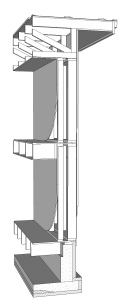
Passive house wall exampleMeeting with colleges of ours to discuss the process of making this project a passive house.  There are a lot of really interesting approaches to building a super efficient building envelop.   Systems like:

  • Double stud walls
  • Rigid insulation over standard stud wall
  • Double stud walls + vapour barrier + interior plumbing electrical wall

All of these systems result in a wall that is at least 1’ thick.

(Reminds me of the Log Houses my Uncle built in the 1980s with the deep window ledges and reading nooks looking out side.)

The system we are leaning towards is the double stud wall system.  Simple, less expensive but harder to air seal. We will implement an Airtight drywall approach to sealing this building (using drywall and paint to create the vapour barrier).

Generous Consideration

A huge opportunity has opened its self up.  The city has agreed to postpone a portion of the Development cost that would upgrade the water main supply from 13mm to 19mm.  Typically projects like this are required to upgrade the water service because of additional fixtures. What we will attempt to prove is that the rainwater collection systems we have planned, combined with the single occupant of the house will mean minimal increase in water usage for the new building.  This opportunity does NOT mean that we have avoided paying the development charges.  What it means is that they have allowed us to delay the expense of the water supply upgrade until renovations/additions are carried out on the existing house.  We should also point out that this opportunity is a one off and we expect that this generous exception will not happen again.

So the rain water system is looking promising once more.  We are considering a redesign of the storage tanks right now and may opt for builtin concrete tank, instead of food grade plastic tanks.  But the system as planned will be collecting rain water into a 9m3 tank (2500 gallons).  This will be cleaned and filtered to near potable standards (including but not limited to 5 micron filter + UV + Black Carbon filter) before it is distributed to the Laundry, toilet (should we need it), and outside irrigation system.  There is some debate about using this light grey water is appropriate in the dish washer.

The City will require their water to feed the kitchen sink, bathroom sink. Laundry sink and shower.

Looking forward to seeing how this project will develop.


Finding the right Supply

A productive visit with staff at Cascadia offices in both Portland and Seattle early January.  A long discussion about material supply chains and the Materials petal.  The major push is to ensure that we are using FSC lumber up here.  This is interesting because to date projects in BC, Canada have not used 100% FSC. Exceptions have been made for “Pine Beetle Kill that would have been Clear cut anyway.”  At the SFU childcare Centre  Kourosh Mahvash came up with a fascinating solution that basically involved purchasing a forest and processing the beetle kill wood with the help of a local mill.

Returning to Kelowna we connected with the Manager for Forest and Environment at Tolko, one of the local mills.  Turns out we connected to the person that had procured Pine Beetle Kill Wood for the building in Penticton.  Further discussion around sustainability and certification outlined for us the complexities of wood supply in BC and Canada.   This aspect of the LBC has many facets and angles to be considered.

At this point our strategy is to connect to Local wood, cut by Local people, milled at plants 120 km from Kelowna.  Long discussion and consideration was given to using all FSC lumber.  It is not making sense both ethically and financially to drive across the boarder to the US to purchase lumber and plywood.  Let us hope that the LBC review board sees it the way we do.